Shrinivas lab

Chemical & Biological Engineering , Northwestern University

Adapted from original art of David Goodsell

Vision

The lab’s vision is to understand and engineer how life works at the molecular and cellular scales. The functions of life emerge from dynamic interactions amongst billions of biomolecules that self-organize in a crowded and squishy cellular environment. We thus adopt an interdisciplinary approach - bridging ideas across biophysics, chemistry, computer science, and engineering to decipher fundamental scientific mechanisms while also pursuing translational applications to impact human health. This approach is bolstered by our extensive local ties (NU Medical School, Applied Math, Center for Synthetic Biology, National Institute for Theory and Math in Biology) and broader collaborations with scientists across the country. Towards and beyond the science, we believe in fostering an environment that supports the well-being and success of all members.

If you are interested in learning more - check out our research, papers, or open positions.

Latest news

Jul 22, 2026 We hung out at the beach, played football (soccer, obviously) and kuub, and got yummy arepas!
Jul 15, 2026 Krishna visits the Marine Biological Labs to give a lecture to the Physiology course! It was electric, as always, and thanks to Amy and Cliff (and all the awesome course faculty and students) for an awesome 2 days!
Jul 07, 2026 Our second cover in as many months - exploring how droplet condensation can classify surfaces - on the front page of PNAS!
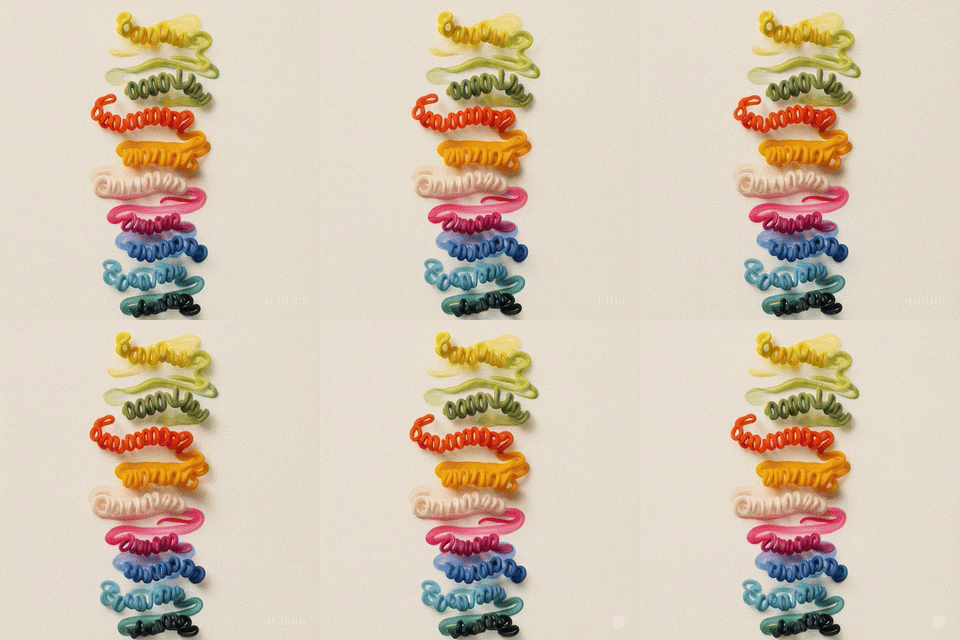
Pictured are dew drops formed by the condensation of water vapor into beads on the surface of a leaf. Cells use similar physical principles to form droplets of biomolecules at specific sites on genomes and other surfaces. Inspired by such physical processes, Aidan Zentner et al. designed fluid systems to spur biomolecules to self-organize and form condensates at surfaces with different compositions within the fluid. The authors’ analysis found that the physics of condensation can drive decision-making in biomolecular systems. According to the authors, the physical processes underlying condensates can play a role beyond compartmentalization and enable information processing and computation. Image credit: Ian Zentner (photographer)

selected publications

  1. Physics-guided design of intrinsically disordered proteins.
    Neha Tyagi=, Jackson Boodry=, Vita Chou, Wilton T Snead, and Krishna Shrinivasc
  2. Information processing driven by multicomponent surface condensates
    Aidan Zentner, Ethan V Halingstad, Cameron Chalk, Michael P BrennerArvind MuruganErik Winfree, and Krishna Shrinivasc
  3. Generalized design of sequence-ensemble-function relationships for intrinsically disordered proteins
    Ryan Krueger, Michael P Brennerc, and Krishna Shrinivasc
  4. Immiscible proteins compete for RNA binding to order condensate layers
    Wilton T. Sneadc, Mary K. Skillicorn, Krishna Shrinivasc, and Amy S. Gladfelterc